For the mom who sits in the driveway before going in

Your favorite room in the house shouldn't be the car in the driveway. If you've been sitting out there with the engine off — this is the way back inside.

It's not the kids, and it's not that he stopped loving you. It's a loop — the more you remind, manage, and try, the further he drifts, and the heavier the house gets. The Set-Down Method is the way out: what to stop, what to rebuild, in what order. It runs on minutes you already have, and he never has to read a page.

Start Tonight — Get the Book

Instant download · 172 pages · 60-day money-back guarantee

If this is your house — or your driveway — keep reading.

  • Some nights you sit in the car in the driveway, engine off, letting a podcast run out. The front door is eleven feet away.
  • Your last forty texts to each other: pickup times, a plumber, whether you have ketchup. You've scrolled back looking for the last 'miss you.' It was a while ago.
  • There's a video in your saved folder about the 'roommate phase.' You've watched it a dozen times. You've never sent it to anyone.
  • You're touched all day — little hands, little needs — and somehow you go to bed feeling like the loneliest woman on the street, eleven inches from your husband.
  • You hand off bedtime with logistics and get 'mm.' You've started rehearsing sentences before you say them to him.
  • You feel more like his mother or his manager than his wife — and you hate the sound of your own reminding voice.
  • On the rare date night, you sit across a restaurant table like two coworkers interviewing each other about a shared project called The Kids.
  • And you'd never call it a bad marriage. No fights, no betrayal, good dad. That's what makes the loneliness so hard to explain — even to yourself.

If your chest got tight reading that list: you're not crazy, you're not ungrateful, and you are very far from alone. What you're living has a name. It's running tonight in good marriages with car seats in the back — and it has a way out that doesn't require him to change first, go to therapy, or even know anything is happening.

A letter from Delia

My six-year-old found me hiding in the driveway. That's the night this book started.

My record was forty minutes.

Groceries done, pickup done, pharmacy done — and then me, parked in my own driveway with the engine off, letting a podcast play all the way out. The episode ended. I sat there anyway. The front door was eleven feet from my bumper and I could not make myself open it.

Here's what makes that embarrassing to admit: nothing bad was waiting inside. Inside was a perfectly decent man on his phone, two kids I'd take a bullet for, and an evening I could have described to you in advance down to the minute. He'd say "hey." I'd say "hey." We'd discuss logistics and food. He'd take the couch, I'd take the kitchen, and at some point I'd realize I'd been narrating my day to a man nodding at a screen.

I wasn't avoiding my house. I was avoiding how alone I felt inside it.

One afternoon in the pickup line I scrolled our texts to see what my marriage actually talked about. Our last forty messages: pickup times, a plumber, whether we had ketchup. I kept scrolling, looking for the last text that wasn't logistics. A "miss you." March. Three years back. I sat there with my thumb on it until the car behind me honked.

And then the night that broke me open, which was small, the way these nights are. I was doing my driveway sit — minute thirty-something — when there was a knock on the window. My daughter. Six years old, barefoot on the concrete, hands cupped against the glass. She grinned at me and said, "Mom. Are we there yet?"

I laughed. Then I cried the whole way through bedtime with my face arranged in mother-shapes, because my six-year-old had found me hiding from my own life in a parked car, and I didn't have one single explanation that wasn't terrifying.

We are roommates, I finally admitted that night. Polite, tired roommates with a mortgage, a shared calendar, and two kids we both love more than we currently like each other.

I want you to know I had tried. God, I'd tried — the calm communicating, the needs explained twice, the chore chart, the scheduled date nights where we interviewed each other, even the counselor's couch, where things got calm for eleven days and then worse. I was the only one trying, the trying wasn't working, and the trying was turning me into a woman whose own voice had an edge on it — even talking to the dog.

What I found at 1 a.m. on an ordinary Tuesday — furious, out of ideas — explained the driveway, the texts, the "mm," all of it. It made me angry for a week. Then it gave me my evenings back.

What's actually happening

You're not losing him. You're both stuck in the same machine — and the kids made it spin faster.

There's a pattern that runs marriages like ours into the ground, and it works like this:

One partner feels the distance and pulls — brings it up, reminds, corrects, plans, reaches. The other feels every pull as pressure and backs away — into the phone, the garage, the "mm." The backing away makes the pulling harder. The pulling makes the backing away farther. Around and around, for years, while you both privately conclude the other one stopped caring. Add two kids and a mental load the size of a second job, and the loop spins faster — because now there's infinite logistics to pull about and zero slack anywhere.

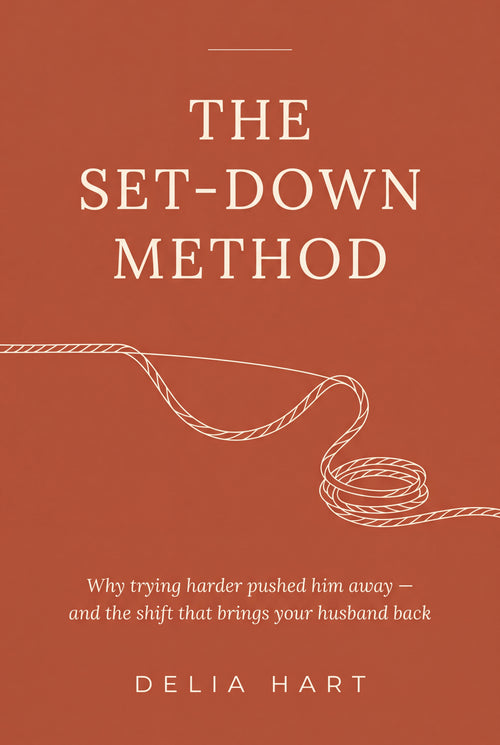
A rope. The harder you pull, the farther he runs.

Now the part that put me on the kitchen floor. When men like our husbands finally say what's happening behind the flat face — and researchers have gotten thousands of them to say it — it's almost never indifference. It's one sentence, over and over:

"Nothing I do is ever enough for her."

He isn't gone. He's braced. And somewhere in the loop, without ever choosing it, you stopped being his wife and became his manager — the household's air traffic control. Nobody flirts with their manager. Nobody relaxes around air traffic control. He didn't stop wanting the woman. The woman got buried under the job.

Which is also, by the way, what the driveway was really about. The car wasn't hiding. The car was the only place where nobody was pulling on either end of you. Not the kids, not the house, not him. Forty minutes of no rope. Your body found the one unbraced room on the property — it just happened to have wheels.

So hear the thing this whole page exists to say: it was never your fault — and it was never only his. You did exactly what every article and podcast told you to do, and every piece of it — communicate more, insist on your 50/50, schedule the talks — was a pull. For a marriage in this loop, the standard advice isn't neutral. It's accelerant. You weren't failing the method. The method was failing you.

The way out

Three moves, in order. All of them yours. None of them need a babysitter.

I ran it in my own house first — exhausted, skeptical, between bedtime and laundry — and then wrote it down so any woman can run it in hers. The whole shape of it:

Move one

Drop the Rope

Stop the pulling — the corrections, the reminders, the campaigns, the meaningful sighs. All of it, even the loving pulls. Not cold; cold is just pulling with better posture. A braced man cannot un-brace while pressure is coming in. Half this move is things you STOP doing — which means it costs a tired mother nothing. You're not surrendering the marriage. You're cutting power to the loop.

Move two

Refill the Well

Into the new quiet, rebuild the only currency a braced man can actually receive: genuine, specific appreciation — and answered bids. The grunt at the TV, the 'huh, look at this' — those are knocks on the door. Couples who last answer them 86% of the time; couples who split, 33%. Every move here takes under two minutes, fits between bedtime and collapse, and requires nothing from him.

Move three

Restore the Spark

Last — never first — the warmth becomes wanting, and the big conversations finally happen the way they never could before: made once, warm, into a warm room. The load talk. The intimacy. The us talk. Order is the whole secret. Everything you tried before wasn't wrong — it was mistimed.

Every move is cited to the researchers who proved it — Gottman's lab, Sue Johnson, Harriet Lerner — so you never have to take my word for anything. But the citations aren't the point. The point is what your ordinary days turn into. Let me show you.

Sixty days from now

Let me walk you through an ordinary Tuesday — yours, two months from tonight.

6:45 a.m. The kitchen is still chaos — it's a school morning, there's no book on earth fixing that — but he's in it now. Packing the lunches next to you, bumping your hip on purpose at the counter, doing the cartoon villain voice about the missing shoe. Same chaos. Different man in it. Same man, actually — that's the whole point.

8:42 a.m. Pickup line, engine idling. Your phone buzzes. Not the plumber, not logistics — a meme. An objectively terrible meme. You stare at it like a love letter, because you remember exactly what forty consecutive texts about ketchup used to feel like.

5:30 p.m. He takes bath time. Unprompted, unannounced — you find out because you hear the shrieking laughter through the ceiling while you sit on the couch doing absolutely nothing, holding a cup of tea that stays hot to the bottom. You will not feel guilty about this. You've done your time.

8:30 p.m. Kids down. He doesn't disappear into the phone — he asks about the thing you mentioned this morning, because he was listening this morning. Later: couch, his hand absent-mindedly on your ankle like it used to live there, some show neither of you is really watching. The silence is the comfortable kind. Somewhere in there you realize you haven't rehearsed a sentence in weeks, and the file — the one you kept updated for years — you've forgotten it exists.

And the driveway? You'll notice it about a month in. You pull up mid-podcast, groceries in the back — and you're out of the car before the episode ends. Didn't decide to. Just were. The door is eleven feet away, and for the first time in years, you want what's behind it.

You don't get a new husband, and you don't get easier kids. You get your evenings back — and the woman who used to live in them.

I can't guarantee your Tuesday — nobody honest can, and the book is blunt about which marriages need more than a book. But that sequence isn't a fantasy. It's a description of an unbraced house — mine, on an ordinary day — and unbraced is buildable. The book is the build order: what to stop, what to start, week by week, for sixty days, in the minutes a mother actually has.

What comes back

You're not buying a book. You're buying back the evenings.

The driveway, retired — the forty-minute sits just stop. Not through discipline — through the inside of the house becoming the better place to be.
A text that isn't logistics — between the pickup times and the plumber, something dumb and just-for-you starts arriving. The 'miss you' comes back mid-scroll, where it used to live.
Bath time, unprompted — the thaw shows up sideways — him taking things you never asked him to take, quietly, without announcing it. That's what it looks like when wanting-to comes back.
The laugh at the sink — he dries while you wash. Some dumb joke lands. You laugh for real — and catch him looking at you over a frying pan like a man who found something he'd been missing.
The woman back — not the manager, not the roommate, not the calendar with a pulse. Rested. Wanted. At peace at 9 p.m. in her own kitchen — and no longer flinching at her own voice.

This is what came back in my own house, in roughly this order, once the loop stopped running — and the research says my house wasn't special. Yours isn't either. That's the entire point.

The benefits, plainly

What you actually walk away with.

The story matters, but you're buying outcomes. Here they are, without the poetry:

Relief by tonight

The first move starts the evening you finish chapter one — and because half the method is subtraction, week one takes work OFF your plate instead of adding homework to it.

The shame off your back, fast

By page eleven you'll know the distance was never proof you weren't enough — it's a documented pattern with decades of research behind it, running in good marriages everywhere.

A husband you can finally read

You'll know what the "mm," the phone, and the garage actually mean — and which of his grunts are knocks on the door that you've been walking past for years.

Two-minute moves that fit a mother's day

Every technique is sized for the minutes between bedtime and collapse. No journaling hour, no couples homework, nothing that needs him to cooperate — or even know.

The words for the hardest moment

When he notices the change and asks "what's gotten into you?" — there's a page for exactly that moment, so the turning point doesn't scare you back into the loop.

A map for the week most women quit

Weeks two and three get prickly before they get warm. The book predicts that week almost hour by hour — so you hold steady three feet from the turn instead of giving up in it.

One load conversation instead of fifty

The fairness talk that's failed for years gets made once, in month two, into a warm room — where the research says it finally sticks.

A calendar, not a philosophy

Sixty days, one small thing per day, laid out in the back of the book — plus an honest chapter on which marriages need more than a book, so you're never gambling blind.

The book

172 pages you can read in the pickup line — and start the same night.

THE SET-DOWN METHOD book cover

Part One names your loop.

The roommate marriage, the machine that runs it, and why everyone's advice backfired — so the shame goes first, before anything else is asked of you. You'll recognize your kitchen by page eleven.

Part Two is Drop the Rope.

What to stop, in what order — including the chapter almost nobody else will tell you about: the strange week where he tests the new weather, gets prickly, asks "what's gotten into you?" — and how to read it as the landing signal it is, instead of quitting three feet from the turn.

Part Three is Refill the Well.

The bid code, the appreciation formula that actually lands on a braced man, and the conversation that isn't about the relationship — small moves, most under two minutes, none requiring his cooperation or knowledge.

Part Four is Restore the Spark.

Out of the mother role, fire needs air, the reach — and the right way to finally have the big conversations, last, into a warm room.

The back of the book is the toolkit.

A 60-Day Quick-Start Calendar that turns the whole method into a daily rhythm · the "What's Gotten Into You?" page for the moment he asks (he will) · straight answers to the questions women actually ask · and an honest guide to getting professional help if your marriage needs more than a book — because some do, and the book says so plainly.

Instant download. On your phone, in the school lot, in the driveway. He never sees a thing unless you want him to.

From the first readers

Real women. Real kitchens.

Let me do the arithmetic the way I did it at my own kitchen table.

One session of couples counseling runs $150–250 — plus the sitter. And if your house is anything like mine was, you've already poured real money into rooms where things got calm for eleven days: the date nights, the apps, the books that blamed you. All of it priced higher than this — and all of it aimed at the wrong target, because none of it un-braces a man.

The Set-Down Method

The Set-Down Method

$37.00

  • The complete 172-page book — instant download, yours forever, any device
  • The 60-Day Quick-Start Calendar
  • The "What's Gotten Into You?" page
  • Straight answers to the questions women actually ask
  • The honest getting-real-help guide
Start Tonight — Get the Book — $37

Instant download · 60-day money back guarantee

One payment, one time, for the map of the loop that's been running your house — and the order of operations out of it. Priced on purpose: so the woman in the pickup line can buy it without a family budget meeting.

The first sixty days

What actually happens — including the part other books skip.

Week one

Quieter.

You set the rope down. The house gets still in a way that's almost unnerving. You'll notice how much of your day was pulling only when you stop. Some women feel relief immediately; most feel strange. Both are on schedule.

Weeks two to three

The test.

He notices the new weather and pokes at it — suspicious, prickly, maybe worse before better. This is the week every quitter quits, and it's the week the book prepares you for almost hour by hour, because the testing is not the method failing. The testing means it landed.

Weeks four to six

The thaw.

Small and sideways, the way thaws come. He lingers in the kitchen. A story you didn't ask for. Bath time, taken without a word. The phone, one night, going face-down on the counter.

Around week eight

The warm room.

The conversations you've been dying to have for years — the load, the us, the spark — finally made once, warm, into a room that can receive them. This is where the fairness talk that failed in year three works in month two. Order was the whole secret.

I can't promise you my ending — nobody honest can, and the book is honest to a fault about which marriages need more than a book. What I can promise is the map, the order, and sixty days of exact instructions that fit inside a mother's day. The rest is your house, and I believe in your house more than you currently do.

Tonight, you could sit in the driveway one minute less.

Not through willpower — through the house changing. The rope goes down tonight, at your own sink, in minutes you already have, without him knowing there's a method in the house.

Two months from now, your evenings feel different — or this cost you nothing.

Start Tonight — Get the Book

Instant download · 172 pages · 60-day money-back guarantee

The honest answers

Everything you're already thinking.

"He won't read a book. He barely reads texts."

He never has to. Every move in the method is yours — half of them are things you stop doing. Most husbands never know there's a method in the house; they just notice the weather change. There's a page in the back for the day he asks what's gotten into you.

"I'm already doing everything. Now the fixing is on me too?"

I sat with that one for a week, so hear the honest answer: half the method is stopping things — the reminding, the correcting, the campaigns — so week one actually takes work off your plate. And the load conversation absolutely happens: in month two, into a warm room, where it finally works. The loop doesn't care whose turn it is. The one who sees the machine is the only one who can switch it off — that's not the punishment, that's the steering wheel.

"We tried counseling. It didn't work — why would a book?"

Because the book isn't more effort at the same target. Weekly rooms where the case gets presented are, for a marriage in this loop, one more pull — which is why so many couples get eleven calm days and then worse. The book runs the opposite order: pressure off first, warmth second, big conversations last. Same research your counselor studied. Different sequence.

"Isn't this just manipulating my husband?"

Manipulation is performing something false to extract something. This is the opposite — you stop performing. You stop the pressure that was never working, and you offer warmth only when you actually mean it; the book is strict about that. He isn't being handled. He's being unhandled, for the first time in years.

"With the kids, when exactly am I supposed to do this?"

In the minutes you already have. Most moves take under two minutes — a specific thank-you, a bid answered, a correction skipped — and the biggest ones are subtractions, which take no time at all. It was built by an exhausted mother, between bedtime and laundry, on purpose. If you have time to sit in the driveway, you have time for this.

"What if my marriage is worse than lonely?"

Then this book is not the tool, and it says so on page one, plainly, before anything is asked of you. If you're afraid of your husband — that's not a loop problem, and the front of the book will point you to the people whose actual job that is, first, before everything.

"How do I know this isn't just your opinion?"

Every technique in the book is cited to the named researcher who proved it — Gottman, Johnson, Lerner, the demand-withdraw literature, all of it, chapter by chapter. Check me. The book is built to survive the checking.

One last thing, and then the button's below.

Somewhere tonight there's a woman in her driveway. Engine off, groceries warming in the back, a podcast she stopped hearing minutes ago, and a front door eleven feet away that she loves everyone behind and still can't make herself open. If that's been you — if a kid has ever knocked on your window — then you already know the sentence I wrote this book to hand you:

You didn't stop loving him. You got tired of pulling. There's a difference, and the difference is fixable — from your side of the house, starting tonight.

Set the rope down. Go inside. I'll show you how, page by page.

— Delia

The Set-Down Method is education, not therapy or medical advice, and Delia Hart is an author, not a licensed clinician. Stories on this page and in the book, including the author's, are composites — real patterns, blended details, changed names — disclosed as such in every book. Results vary by marriage and by practice; no outcome is guaranteed. If you are in an unsafe relationship, please start with the resources at the front of the book or the National Domestic Violence Hotline (1-800-799-7233, text START to 88788). 60-day money-back guarantee honored on every order, no questions asked. © Delia Hart. All rights reserved.