For the wife who's the only one trying
Every book you've read handed you more to do. This one starts by taking something off you. The Set-Down Method is the way out: what to put down first, what to rebuild after, and in what order — moves small enough for the ten minutes you have left at nine o'clock. Starting tonight, without him ever knowing there's a method in the house.


If you read that list with your chest getting tight — you're not crazy, and you're not alone. What you're living has a name. It's running in good marriages right now, tonight, in kitchens exactly like yours. And it has a way out that doesn't require him to change first.
A letter from Delia

That was the trouble. Nothing had been happening for three years.
We had dinner. The kids went down late. He took the couch and his phone; I took the kitchen and mine. At some point I said, "Did you call about the car?" and he said, "I'll do it tomorrow," and that was the entire connection, that day, between two people who once drove four hours through the rain to spend a single night in the same city.
I stood at the sink drying a pan that was already dry, and I finally let myself finish the sentence I'd been outrunning for months:
Here's what you need to know about the woman at that sink. She was not weak. She was not passive. God, no — she was trying, harder than she had ever tried at anything. If you'd asked her who was to blame, she could have produced the file. She kept the file updated. She knew exactly how many bedtimes she'd done alone that month, how many appointments she'd remembered that he'd forgotten, how many conversations she'd started that died on "mm."
She was right about all of it.
She was right, and she was so lonely she'd started crying in the shower where the water could take the credit.
So she did what every article, every podcast, every well-meaning friend told her to do. And that — the doing of exactly what everyone says to do — is where this story actually starts.
And somewhere in there, I stopped recognizing my own voice. It had an edge on it all the time now. Even talking to the dog.
Sound familiar? It should. You are the only one trying, the trying isn't working, and the trying is starting to cost you the woman you used to be.
Here's the part nobody says out loud. This doesn't hold still. Every month the distance runs, it gets one month more practiced. The pulling gets more automatic. The bracing gets thicker. Couples don't usually end because of one bad night — they erode, politely, on schedule, while both people wait for the other one to notice.
What I found at 1 a.m. on an ordinary Tuesday, furious and out of ideas — it made me angry for a week. Then it gave me my marriage back.
What's actually happening
There's a pattern that runs marriages like yours into the ground, and it works like this:
One partner feels the distance and pulls — brings it up, reminds, corrects, plans, reaches. The other feels every pull as pressure and backs away — into the phone, the garage, the "mm." The backing away makes the pulling harder. The pulling makes the backing away farther. Around and around, for years, while you both privately conclude the other one stopped caring.
Now the part that put me on the kitchen floor. When men like your husband finally say what's happening behind the flat face — and researchers have gotten thousands of them to say it — it's almost never indifference. It's one sentence, over and over:
He isn't gone. He's braced. The phone you've spent years reading as a wall is, some nights, a white flag — he came to the room you're in. In his broken, maddening, ten-percent code — that's the reach.
And somewhere in the loop, without ever choosing it, you stopped being his wife and became his manager. Nobody flirts with their manager. Nobody banters with air traffic control. He didn't stop wanting the woman — the woman got buried under the job.
So let me say the thing this whole page exists to say: it was never your fault — and it was never only his. You did exactly what everyone told you to do. That's the problem. Every piece of standard advice — communicate more, insist on your 50/50, schedule the talks — is a pull. For a marriage caught in this loop, the advice isn't neutral. It's accelerant. The more skillfully you communicated, the faster he backed away.
You weren't failing the method. The method was failing you.
The way out
I ran it in my own house first — alone, skeptical, exhausted — and then wrote it down so any woman can run it in hers. Here's the whole shape of it:
Move one
Stop the pulling — all of it, even the loving pulls. The corrections, the reminders, the campaigns, the meaningful sighs. Not cold; cold is just pulling with better posture. This is the counterintuitive part, and it works for a simple reason: a braced man cannot un-brace while pressure is still coming in. You are not surrendering the marriage. You are cutting the power to the loop.
Move two
Into the new quiet, rebuild the only currency a braced man can actually receive: genuine, specific appreciation — and answered bids. That grunt at the TV, the "huh, look at this" — those are knocks on the door. Couples who last answer them 86% of the time; couples who split, 33%. He's been knocking in a code nobody taught you to read. This part teaches you the code.
Move three
Last — never first — the warmth becomes wanting, and the big conversations finally happen the way they never could before: made once, warm, into a warm room. The load talk. The intimacy. The us talk. Order is the whole secret. Everything you tried before wasn't wrong — it was mistimed.
Every move in the book is cited to the researchers who proved it — Gottman's lab, Sue Johnson, Harriet Lerner — so you never have to take my word for anything. But the citations aren't the point. The point is what starts coming back once the pulling stops.
What comes back
I can't promise you dates and times — nobody honest can. I can tell you this is what came back in my own house, in roughly this order, once the loop stopped running — and the research says my house wasn't special. The book's job is to get you there on purpose instead of by accident.
The benefits, plainly
The story matters, but you're buying outcomes. Here they are, without the poetry:
The first move starts the evening you finish chapter one — and because half the method is subtraction, week one takes work OFF your plate instead of adding homework to it.
By page eleven you'll know the distance was never proof you weren't enough — it's a documented pattern with decades of research behind it, running in good marriages everywhere.
You'll know what the "mm," the phone, and the garage actually mean — and which of his grunts are knocks on the door that you've been walking past for years.
Every technique is sized for the minutes between bedtime and collapse. No journaling hour, no couples homework, nothing that needs him to cooperate — or even know.
When he notices the change and asks "what's gotten into you?" — there's a page for exactly that moment, so the turning point doesn't scare you back into the loop.
Weeks two and three get prickly before they get warm. The book predicts that week almost hour by hour — so you hold steady three feet from the turn instead of giving up in it.
The fairness talk that's failed for years gets made once, in month two, into a warm room — where the research says it finally sticks.
Sixty days, one small thing per day, laid out in the back of the book — plus an honest chapter on which marriages need more than a book, so you're never gambling blind.
The book

The roommate marriage, the machine that runs it, and why everyone's advice backfired — so the shame goes first, before anything else is asked of you.
What to stop, in what order — including the chapter almost nobody else will tell you about: the strange week where he tests the new weather, gets prickly, asks "what's gotten into you?" — and how to read it as the landing signal it is, instead of quitting three feet from the turn.
The bid code, the appreciation formula that actually lands on a braced man, and the conversation that isn't about the relationship — small moves, most under two minutes, none requiring his cooperation or knowledge.
Out of the mother role, fire needs air, the reach — and the right way to finally have the big conversations, last, into a warm room.
A 60-Day Quick-Start Calendar that turns the whole method into a daily rhythm · the "What's Gotten Into You?" page for the moment he asks (he will) · straight answers to the questions women actually ask · and an honest guide to getting professional help if your marriage needs more than a book — because some do, and the book says so plainly.
Instant download. Read it on your phone in the pickup line. He never sees a thing unless you want him to.
From the first readers
★★★★★
My own therapist gave me this book so I could try something new after my husband refused to keep doing therapy. The method is actually liberating, and now me and my husband are closer than we've ever been. Totally recommend it if you are desperate to fix your relationship

Anna
Married for 20 years
★★★★★
I was very tired of having to manage my home and not having someone to help me. Don't get me wrong, my husband did EVERYTHING that I asked, above and beyond... but my issue is that if I didn't ask, nothing would be done. Now... 3 months later, everything is completely different. Every wife should read this book, not matter how good or bad your relationship is!

Theressa
Married for 5 years
★★★★★
My big sister gave me this book the day after we had a party at her house. She said that as soon as she saw me and my husband, she knew I needed to read it. She told me, keep an open mind and just read it... you'll understand why I am giving it to you. Oh, she was right... first chapter and I identified myself in it... like it was talking about my life. It's been 4 weeks and things are changing...

Laura
Married for 3 years - Together for 17
★★★★★
If you are looking for a book to tell you to express yourself more, to demand more, to communicate more... this is not the book for you. This is completely the opposite. In few words, relax, take care of yourself, and somehow (I still don't understand it myself) your husband will wake up one day completely different, and the life you wanted will be yours. I know... weird... but it works!

Maria
Married for 11 years
One session of couples counseling runs $150–250 — and if your house is anything like mine was, you've already poured a few thousand dollars into rooms where things got calm for eleven days. The date nights, the apps, the books that blamed you — all of it priced higher than this, and all of it aimed at the wrong marriage.
The Set-Down Method

$37.00
Instant download · 60-day money back guarantee
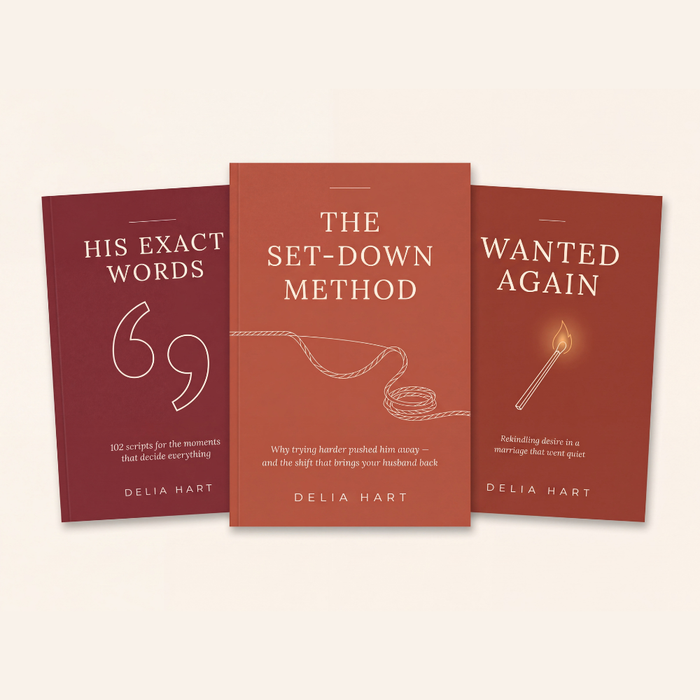
The Complete Library — All 3 Books

$81$59.00
Instant download · 60-day money back guarantee
One payment, one time, for the map of the loop that's been running your house — and the step by step guide to get out of it.
The first sixty days
Week one
You set the rope down. The house gets still in a way that's almost unnerving. You'll notice how much of your day was pulling only when you stop. Some women feel relief immediately; most feel strange. Both are on schedule.
Weeks two to three
He notices the new weather and pokes at it — suspicious, prickly, maybe worse before better. This is the week every quitter quits, and it's the week the book prepares you for almost hour by hour, because the testing is not the method failing. The testing means it landed.
Weeks four to six
Small and sideways, the way thaws come. He lingers in the kitchen thirty seconds past necessary. A story from work you didn't ask for. The phone, one night, going face-down. You'll have stopped keeping the file by now — and that, quietly, will turn out to be its own reward.
Around week eight
The conversations you've been dying to have for years — the load, the us, the spark — finally made once, warm, into a room that can receive them. This is where the fairness talk that failed in year three works in month two. Order was the whole secret.
I can't promise you my ending — nobody honest can, and the book is honest to a fault about which marriages need more than a book. What I can promise is the map, the order, and sixty days of exact instructions. The rest is your house, and I believe in your house more than you currently do.
This is the first thing that doesn't ask you to try harder — it asks you to try different, in an order that actually moves a braced man.
Tonight, at your own sink, without him knowing there's a method in the house — the rope goes down. Two months from now, your kitchen either feels different or this cost you nothing.
Instant download · 172 pages · 60-day money-back guarantee
The honest answers
He never has to. Every move in the method is yours — half of them are things you stop doing. Most husbands never know there's a method in the house; they just notice the weather change. There's a page in the back for the day he asks what's gotten into you.
No. It tells you the loop is nobody's fault and the steering wheel is in your hand — those are different sentences. There's no submission in it, no performance, no 1950s. It's closer to traffic engineering than charm school: here's the machine, here's what feeds it, here's what to stop feeding first. The strong, competent woman you are is exactly who it was written for.
Because the book isn't more effort at the same target. Weekly rooms where the case gets presented are, for a marriage in this loop, one more pull — which is why so many couples get eleven calm days and then worse. The book runs the opposite order: pressure off first, warmth second, big conversations last. Same research your counselor studied. Different sequence. (And the back of the book will point you to the two kinds of therapy that specialize in exactly this loop, for the marriages that need more.)
Manipulation is performing something false to extract something. This is the opposite — you stop performing. You stop the pressure that was never working, and you offer warmth only when you actually mean it; the book is strict about that. He isn't being handled. He's being unhandled, for the first time in years.
I don't know your house, so I won't pretend to. I know this loop is the most common road to "irreconcilable," and that unwinding it changes more than most people believe from inside year three of the freeze. That's what the sixty days and the guarantee are for: run it honestly, and either your home changes or your money comes back.
Then this book is not the tool, and it says so on page one, plainly, before anything is asked of you. If you're afraid of your husband — that's not a loop problem, and the front of the book will point you to the people whose actual job that is, first, before everything.
Every technique in the book is cited to the named researcher who proved it — Gottman, Johnson, Lerner, the demand-withdraw literature, all of it, chapter by chapter. Check me. The book is built to survive the checking.
Tonight there are thousands of women standing at sinks, drying pans that are already dry, doing the math on how long it's been. Keeping the file. Being right, and being so lonely about it. You've been one of them — and if this page found you the way these things tend to find us, at 1 a.m., saved and not sent to anyone — then you already know the sentence I wrote this book to hand you:
Set the rope down. I'll show you how, page by page.
The Set-Down Method is education, not therapy or medical advice, and Delia Hart is an author, not a licensed clinician. Stories on this page and in the book, including the author's, are composites — real patterns, blended details, changed names — disclosed as such in every book.